Rachel Taylor stepped off a bus near the Penn State campus after 1am on March 28, 1940. The 17-year old first-year student from Wildwood, New Jersey was returning to campus after Easter Break. When another student on the bus offered her a car ride to campus, she turned her down despite the cool, rainy night. Her dormitory was nearby and she liked to walk. Passersby reported seeing her on her way down College Avenue. She never arrived. Her roommate reported her missing at dawn.
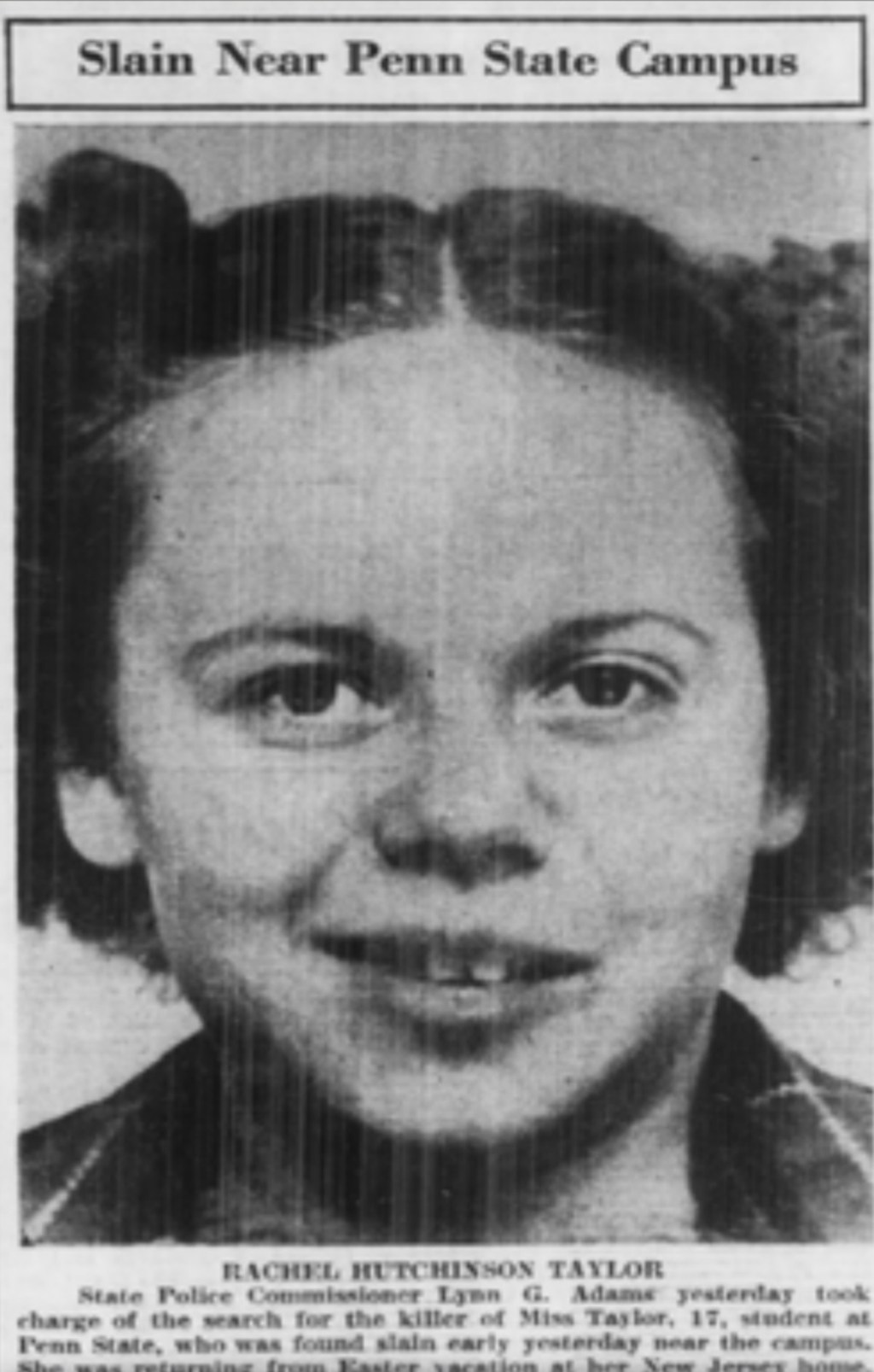
When Harold Leightley, the janitor at the newly-built Lemont Consolidated School, three miles northeast of State College, arrived at work at 6:30am on March 28, he found Rachel Taylor’s body in the school parking lot. Her skull had been fractured, her clothes had been pulled up over her head, and her torso had been bludgeoned. An autopsy performed hours after her body was found confirmed a fatal skull fracture, multiple wounds from a heavy weapon on her face and head, probable bite marks beneath her right breast, and multiple deep puncture wounds in her pubic area. There were no wounds on her arms and legs. The location and type of her injuries led headlines to proclaim she had been killed by a “sex maniac.”
The scenario that investigators pieced together was that Taylor had walked part of the way down East College Avenue to her dormitory when she was somehow drawn into a car and driven to Lemont.
Police estimate that Taylor was murdered sometime after 3:15am, the time showing on her broken watch. As the killer fled to the northeast, toward Bellefonte, he threw her luggage out the window of his car near the cemetery of the Shiloh Lutheran Church two miles away.
It was a straight shot from State College to Bellefonte, a drive that passed the driveway of the newly constructed Lemont Consolidated School, Shiloh Lutheran Church, and, ominously, the stone sentinel of Rockview Prison. A place where Hoy Houck would spend a few years and where William Wilson would spend his last days.
Eyewitness statements were unable to produce any solid information about precisely where or how Rachel Taylor had been drawn into the car or the description of the car and the driver. Attention focused first on a tall, dark haired, slender young man who was reported to have been harassing women in State College a few days earlier. Similar reports were made at the same time in Bellefonte, ten miles northeast of State College. That man was never identified.
Nagle Young, a State College resident who had traveled to Philadelphia for work near the time of the murder, was arrested there on March 29 after blood was seen on his clothes. The prospect of a fast resolution to the horrific murder faded quickly after Young’s movements were found not to match the timeline of the crime and he provided a plausible account of the blood. He was released the next day.
Over the first few days, hundreds of people were questioned, including recently-released inmates from nearby Rockview State Prison, friends and associates of Rachel, fellow bus passengers, and various disreputable characters. Seemingly more concerned about their image and their future admissions, college authorities blamed Rachel for failing to accept a ride or to notify college authorities of her late arrival and advanced an unsupported and callous theory that she had been hit by a car rather than assaulted.
Despite an investigation led by Lynn Adams, the commissioner of the Pennsylvania Motor Police, the state’s most powerful law enforcement agency, police were unable to develop any solid clues. Within days, the case fell out of the headlines and settled into a routine investigation. Reports indicated that police “were up against a stone wall.”
Police knew approximately where and when Taylor was lured into a car, but were unable to answer how a person unwilling to accept a ride from a classmate and carrying two pieces of luggage was lured into a car without being noticed, even on quiet streets in the middle of the night.
 To and From Bellefonte